A farm pond looks simple: a patch of water, a bank, a place to stand. But to a fish, a pond is a layered, shifting neighborhood with safe corners, risky open space, warm and cool zones, and places where food gets delivered. Once you understand why bass and bluegill choose the spots they do, you can stop wasting casts on empty water and start fishing where the odds are better.
This guide draws on state wildlife agencies, university extension programs, and respected bass-fishing authorities. It focuses on largemouth bass and bluegill, a common pairing in farm ponds. Every pond is different, and fish behavior shifts with season, weather, and region, so treat what follows as a reliable starting framework rather than a guarantee.
Is the Middle of a Pond Really Empty?
You will often hear that the center of a pond holds no fish at all. That is an overstatement, but there is real science behind the advice to look elsewhere first. Two things work against open water: a lack of structure and, in summer, the chemistry of deeper water.
Fish follow cover and edges
Fisheries biologists consistently describe largemouth bass as structure-oriented. The Wisconsin Department of Natural Resources lists the places bass call home as inflowing or outflowing streams, points, submerged trees, docks, stumps, vegetation beds, rock, and drop-offs. Plain open water offers none of that. Bluegill and young bass use cover for protection, and bass use it to ambush prey, so the featureless middle of a pond gives neither group much reason to linger.
Oxygen can limit how deep fish can live in summer
Water is densest at about 39 degrees Fahrenheit, which is why pond water sorts itself into layers as the weather warms (University of Missouri Extension; University of Illinois Extension). In a stratified pond, a warm upper layer sits on top of a cold, dense bottom layer, with a thin transition zone called the thermocline in between. In hot, calm summer weather the layers rarely mix.
That matters because the bottom layer cannot refill its oxygen from the air or from sunlit plants and algae. Decomposing organic matter keeps using oxygen there, and by late summer the deep layer can be nearly depleted (New Mexico State University; Virginia Department of Wildlife Resources). Fish begin to be stressed when dissolved oxygen falls below roughly 3 parts per million (Clemson Cooperative Extension).
A popular rule of thumb says that everything below about 8 feet is off limits to fish in summer. The research says it is not that tidy:
- Ponds shallower than roughly 6 to 8 feet may not stratify at all, because moderate winds keep the water circulating, while ponds of 10 to 12 feet or more almost always do (University of Missouri Extension).
- Even in stratified ponds, the depth where oxygen runs out depends on the pond, the season, and how much organic material is decomposing on the bottom. A dissolved oxygen meter is the only way to know for sure (Clemson Cooperative Extension).
- Deep water is not useless. Oregon’s wildlife agency notes that during the hottest part of summer, largemouth bass often move to deeper, cooler water during bright midday hours. The key is whether that deeper water still has oxygen.
In short, the deep center of a pond is most likely to be unproductive in a deep, stratified pond in late summer, and much less so in a shallow pond or in cooler months.
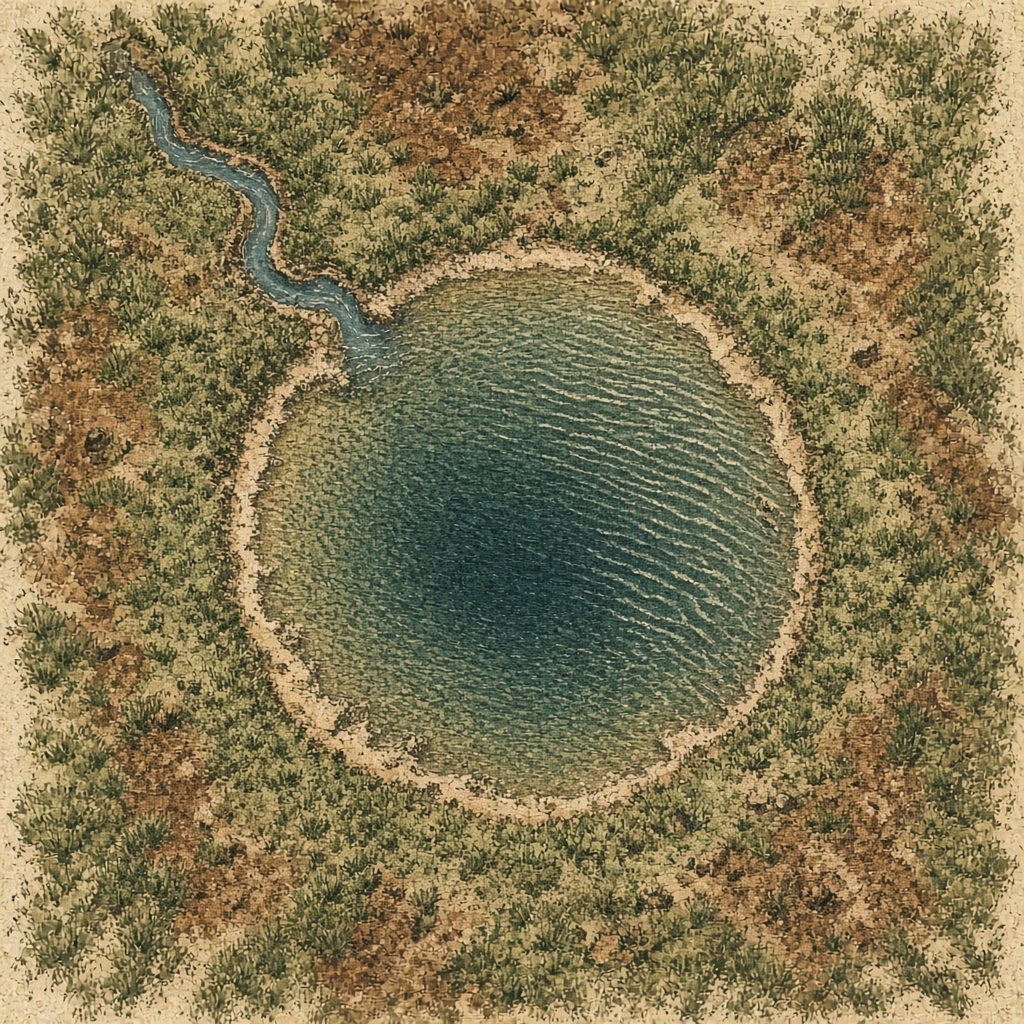
Where Bass and Bluegill Actually Hold
Banks and shallow edges
Shallow water near the bank is often more productive than people expect. The Kentucky Department of Fish and Wildlife Resources reports that after a few warm days in spring, largemouth bass move into water two feet deep or less, tucking up against the bank, into small cuts, and into clumps of shoreline grass. Banks that drop quickly into deeper water are especially good for working a lure parallel to the shore, and the dam face is a prime choice on small lakes.
Later in the year the same logic holds. Indiana’s Department of Natural Resources advises summer bass anglers to begin in shallow water around overhanging branches, docks, and vegetation, and to fish early in the morning, late in the afternoon, and even at night.
Cover, but not too much of it
Sunken trees, brush piles, stumps, and patches of plants all give fish places to hide and feed. Wisconsin DNR suggests looking for the spots that differ slightly from the rest of the cover, such as a pocket or point inside a cattail edge or a lone patch of plants.
There is a catch. The Missouri Department of Conservation recommends that roughly 10 to 20 percent of a pond have aquatic plants, because too many allow young bluegill to hide so well that bass cannot thin them out. The result is stunted bluegill and fewer large bass. Kentucky wildlife biologists make the same point: dense vegetation and heavy brush can limit how well bass forage. So when you find a pond choked with weeds, a sensible place to start is along the edges of the plants and in any open pockets rather than deep inside the thickest growth.
The wind-blown bank
Indiana DNR’s seasonal advice for cooler weather is to cast toward the wind-blown shoreline, because wind pushes warm surface water and food into the shallows on that side. Anglers commonly extend the same idea to other seasons: drifting food attracts small fish, and small fish attract bass. The agency documentation focuses on early-season conditions, so the year-round version is best understood as well-established angling logic rather than a published rule. Oregon’s wildlife agency adds a practical note that spinnerbaits and crankbaits work well when the water is rough or choppy.
Inflows: creeks, ditches, and drains
Wisconsin DNR lists inflowing streams among the places bass favor, and Iowa DNR notes that incoming creeks or field-tile flows are often a few degrees warmer than the lake in spring and draw many species. Iowa’s advice is to watch for current seams and for darker water meeting clear water. The agency sources document the attraction. The most common explanation is that flowing water delivers food and a change in conditions, which gives fish a reason to hold near it.
After a rain: reading the mudline
Runoff typically enters a pond at its inflows, so the first muddy water appears there and then spreads out until it meets clearer water. The visible edge is called a mudline.
Bass-fishing authorities treat a mudline like a weed edge. Bass Resource describes bass holding inside the muddy water and darting into the clearer water to catch passing prey, and recommends fishing the edge with crankbaits, spinnerbaits, or plastics. Bassmaster’s profile of professional angler Kevin VanDam adds that bass tend to sit on the edge or inside the stained water rather than in the clear, that sharply defined lines generally fish better than murky, blended ones, and that he angles his retrieve across the line at about 45 degrees to the wind and the mudline. Another Bassmaster article points out that a mudline may be only a foot or two deep, so it is worth fishing the mudline itself rather than skipping over it.
Timing changes the picture. According to Bass Resource, after several days of heavy rain most of a body of water can turn muddy, and the cleanest water may then show up first at the inflows, which is where to look. Kentucky biologists note that spring rains that cloud the water can pull largemouth into shallow coves and the upper end of farm ponds.
Two cautions are worth knowing:
- If the rain arrived with a cold front, the bite can slow considerably in the day or two afterward. Bass Resource suggests smaller baits and finesse presentations in those conditions.
- Heavy, cold rain can cause a stratified pond to mix suddenly, spreading oxygen-poor bottom water through the whole pond. Extension and wildlife agencies in Missouri, New Mexico, South Carolina, and Virginia all warn about this. If you see fish gulping at the surface, especially at dawn, the pond has an oxygen problem. Contact your state fisheries biologist or extension office rather than expecting a good bite.
How to Approach the Water
Where you stand matters nearly as much as where you cast. Kentucky’s wildlife agency advises anglers to walk softly, keep low, and wear drab colors, and warns that bass spooked from the shallows may not bite again for hours. It also recommends casting onto the bank and pulling the lure gently into the water rather than splashing it down on top of the fish. These tips are written for shallow-water bass fishing, but the principle holds anywhere fish are close to shore: a quiet approach keeps the nearest, easiest fish in play.
A Simple Game Plan for Your Next Pond Trip
- Check the weather and the season first. Warm spells, cold fronts, and recent heavy rain all change where fish hold.
- Approach quietly and stay back from the edge, then work the bank before you cast far out.
- Look for cover: stumps, brush, overhanging branches, plant edges, and dam faces.
- Note the wind direction and give the windward bank a try.
- Find inflows and watch for current seams or color changes.
- After rain, look for a distinct mudline and fish across it.
- In hot summer weather, fish early and late, and remember that midday fish may be deeper where oxygen allows.
Frequently Asked Questions
Do fish ever hold in the middle of a pond?
Yes. Fish can and do use open or deeper water, especially around isolated structure, during bright midday summer conditions, or in cooler seasons. The advice is to start with cover and edges, which offer food and protection, and to treat the center as a second option.
How deep is too deep to fish a pond in summer?
There is no single number. Shallow ponds may not stratify at all, while ponds of 10 to 12 feet or more nearly always do, and the oxygen-poor layer can start at different depths from pond to pond and from week to week. A dissolved oxygen meter is the reliable way to find out.
What is the best time of day to fish a pond?
Iowa DNR notes that summer bass are most active in the early morning and late evening, and Indiana DNR recommends early morning, late afternoon, and night in summer. In spring, Indiana advises fishing late in the day to let the sun warm shallow water.
Why do I get no bites right at the bank?
Fish in shallow water are easy to spook. Walking heavily, standing too close, or splashing a lure down can send them away, and Kentucky biologists say spooked bass may not bite for hours. Stay low, stay back, and cast softly.
Is fishing after a rain a good idea?
It can be excellent or frustrating. A well-defined mudline near an inflow can concentrate bass, but a cold-front rain can shut the bite down. Heavy cold rain can also stress oxygen levels in deep, stratified ponds, so keep an eye out for fish gasping at the surface.
Does all of this apply in winter?
Not entirely. Pond layering and oxygen conditions change with the seasons, including under ice, and fish behavior changes with them. A winter guide is a topic for a future post on The Inquisitive Journal.
Final Thoughts
A pond rewards anglers who read it like a map: edges and cover first, the windward bank next, then the places where water enters, and the line where muddy meets clear after a storm. Stay quiet, pay attention to the weather, and keep an eye on oxygen, and the water will start to make sense.
If you are heading out at sunrise in boots and a ball cap, we would love to see you in something from Ranch and Rebel Apparel. We are a western and country apparel and gift shop, not a tackle shop, so leave the fish talk to the biologists and browse the collection at ranchandrebel.com.
Sources
- University of Missouri Extension, “Managing Ponds and Lakes for Aquaculture and Fisheries in Missouri: Pond Dynamics and Water Quality Considerations” (G9476): https://extension.missouri.edu/publications/g9476
- New Mexico State University, “Understanding and Preventing Fish Kills in Your Pond” (W105): https://pubs.nmsu.edu/_w/W105/
- Clemson Home and Garden Information Center, “Pond Turnover and Dissolved Oxygen”: https://hgic.clemson.edu/factsheet/pond-turnover-and-dissolved-oxygen/
- Virginia Department of Wildlife Resources, “Pond Management: Fish Kills”: https://dwr.virginia.gov/fishing/private-pond-management/fish-kills/
- University of Illinois Extension, “Farm Ponds, Fish Kills and Oxygen”: https://extension.illinois.edu/news-releases/farm-ponds-fish-kills-and-oxygen
- Kentucky Department of Fish and Wildlife Resources, “Farm Ponds and Small Lakes”: https://fw.ky.gov/Fish/Pages/Farm-Ponds-and-Small-Lakes.aspx
- Kentucky Department of Fish and Wildlife Resources, “Farm Pond Management: Managing Fish Populations and Improving Habitat”: https://fw.ky.gov/Fish/Pages/Farm-Pond-Management-Fish-Populations.aspx
- Missouri Department of Conservation, “Aquaguide: Managing for Trophy Largemouth Bass in Ponds and Lakes”: https://mdc.mo.gov/sites/default/files/2022-05/trophy_bass_management_Jan2022.pdf
- Indiana Department of Natural Resources, “Fishing Tips: When and Where”: https://secure.in.gov/dnr/fish-and-wildlife/education-programs/learn-to-fish/fishing-tips-and-videos/fishing-tips-when-and-where
- Wisconsin DNR, “Hook Your Catch With These Tips”: https://dnr.wisconsin.gov/topic/Fishing/outreach/hookyourcatch.html
- Iowa DNR, “Largemouth Bass”: https://www.iowadnr.gov/things-do/fishing/iowa-fish-species/largemouth-bass
- Oregon Department of Fish and Wildlife, “Bass Fishing”: https://myodfw.com/fishing/species/bass
- Bass Resource, “Fishing After It Rains” (Glenn May, 2024): https://www.bassresource.com/bass-fishing-videos/fish-after-rain.html
- Bassmaster, “KVD: Fishing Mudlines” (Matt Pangrac, 2011): https://www.bassmaster.com/how-to/news/kvd-fishing-mudlines/
- Bassmaster, “Stick to Clay for Success” (John N. Felsher, 2008): https://www.bassmaster.com/how-to/news/stick-to-clay-for-success/

