Jupiter and Mars are two of the most easily identifiable planets in our solar system, visible to the naked eye from Earth. Both planets are bright, red-tinted points of light in the night sky, but one may wonder why Jupiter appears brighter than Mars, despite being farther away from Earth. The answer lies in a combination of factors, including the size and composition of the planets, as well as their distance from the sun.
First, let’s consider the size of the planets. Jupiter is the largest planet in our solar system, with a diameter of about 86,881 miles, more than ten times the size of Earth. Mars, on the other hand, is about half the size of Earth, with a diameter of about 4,212 miles. Because Jupiter is so much larger than Mars, it reflects more light, making it appear brighter in the night sky.
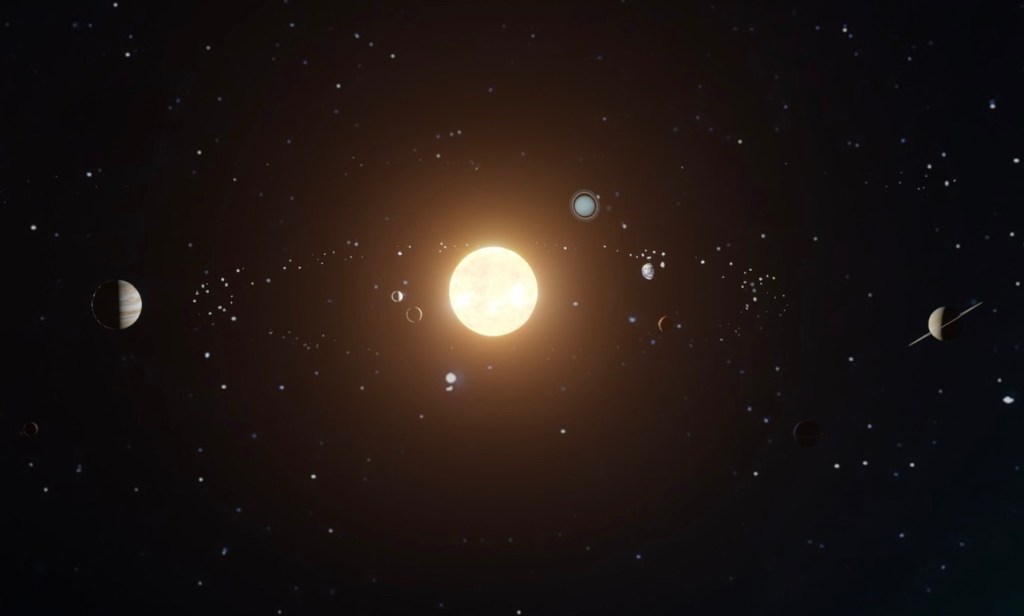
Next, let’s consider the distance between the planets and the sun. Jupiter is farther from the sun than Mars, and therefore receives less sunlight. However, Jupiter’s atmosphere is composed of gases that reflect sunlight well, including hydrogen, helium, and methane. This reflective quality of Jupiter’s atmosphere enhances its brightness in the night sky, making it more visible than Mars.
Another factor that affects the brightness of the planets is their distance from Earth. While Mars is closer to Earth than Jupiter, it is not always as visible due to its orbital path. Mars has a more elliptical orbit, meaning it can be much farther from Earth at some points in its orbit than at others. This can make Mars appear dimmer and harder to see in the night sky at certain times, even when it is closer to Earth than Jupiter.
In addition to size, composition, and distance, another factor that can impact the brightness of Jupiter and Mars is their relative positions in the sky. When a planet is closer to the sun, it is more likely to appear near the horizon during the day, when sunlight can interfere with our ability to see it clearly. Jupiter, however, is farther from the sun than Mars, so it is more likely to be visible at night when it is high in the sky and not obscured by sunlight.
Finally, it is worth noting that the brightness of Jupiter and Mars can also be affected by atmospheric conditions on Earth. Air pollution, dust, and other particles in the atmosphere can make the planets appear dimmer or more obscured, while clear skies and optimal viewing conditions can make them appear brighter.
In summary, the reasons why Jupiter appears brighter in the night sky than Mars, even though Mars is closer to Earth, are due to a combination of factors, including the size and composition of the planets, their distance from the sun, their relative positions in the sky, and atmospheric conditions on Earth. While both planets are fascinating objects to observe in the night sky, understanding the factors that impact their brightness can enhance our appreciation of their beauty and uniqueness in our solar system.
If you enjoyed reading this blog post and found it informative, we kindly ask that you consider leaving us a comment below and liking and sharing it with your friends and family. By doing so, you’ll be helping us reach a wider audience and spreading valuable information to those who may find it helpful. Additionally, your support means a lot to us, and it motivates us to continue creating high-quality content that you’ll enjoy. So, thank you for taking the time to read our blog, and we hope to see you again soon!
Readers: Note that the email address and logging in prompts do appear for comments on this blog, but providing an email address and logging in are not required.
 The Inquisitive Journal