Giant statues have always captivated the human imagination, and none more so than those of ancient Egypt. One particular statue that has recently caught the attention of researchers is the face of Ramses, located in Luxor. What makes this statue so remarkable is the degree of symmetry it displays, something that is virtually impossible to achieve by hand.
Many people assume that the statue was created through manual labor, but the level of precision and perfection seen in the face of Ramses is too exact to have been achieved without the aid of advanced technology. In fact, modern engineers and construction experts have struggled to replicate this level of symmetry even with the aid of machines.
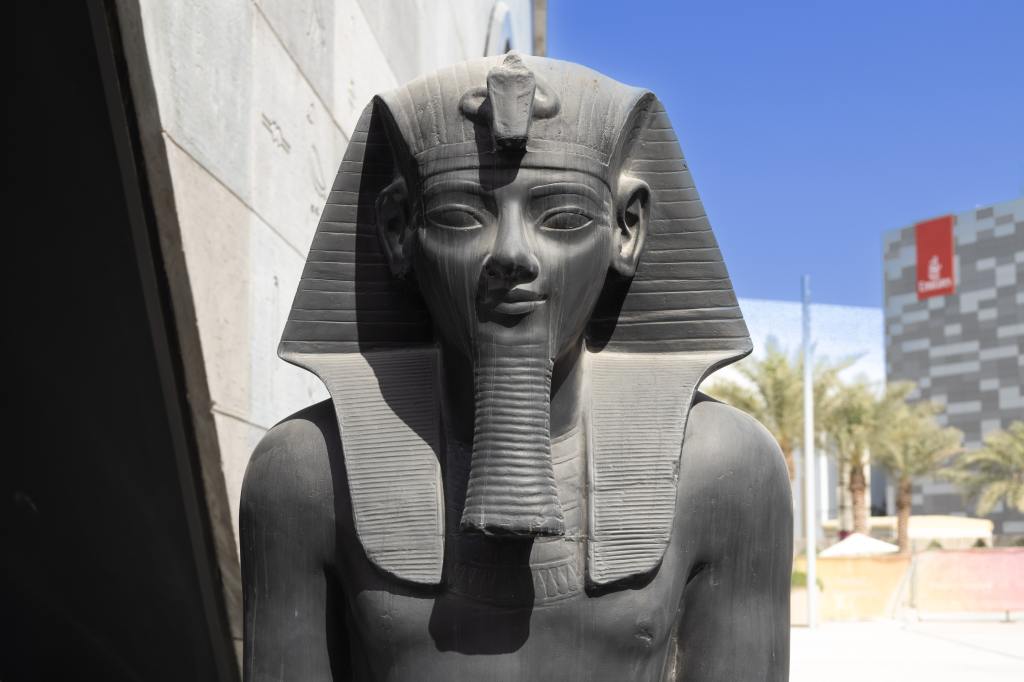
The face of Ramses is perfectly symmetrical, both left to right and front to back. This level of perfection is not something that is typically seen in artwork, even that which is created with the most advanced tools available. Michelangelo’s David, for example, is a beautiful statue, but it is not perfectly symmetrical.
So how did the ancient Egyptians achieve such a high degree of symmetry in their statues? The prevailing theory among modern archaeologists is that they did it by hand. While this may seem like a simple explanation, it fails to take into account the level of precision and consistency seen in the face of Ramses.
To illustrate the difficulty of achieving this level of symmetry by hand, researchers have taken a photograph of the face of Ramses and flipped it. When viewed in this manner, the face is still perfectly symmetrical. This is not something that can be achieved by simply eyeballing a statue and doing it by hand.
The level of precision seen in the face of Ramses is a testament to the ingenuity and technological prowess of the ancient Egyptians. It is a reminder that they were a civilization far more advanced than we typically give them credit for. Their achievements in engineering, mathematics, and art continue to inspire and mystify us to this day.
As we continue to study the faces of giant statues, we will no doubt uncover even more secrets and marvels. It is a reminder that even after thousands of years, there is still so much we can learn from the ancient world. Whether through technological advancements or simple perseverance, we can continue to unlock the secrets of the past and bring them into the light of the present.
If you enjoyed reading this blog post and found it informative, we kindly ask that you consider leaving us a comment below and liking and sharing it with your friends and family. By doing so, you’ll be helping us reach a wider audience and spreading valuable information to those who may find it helpful. Additionally, your support means a lot to us, and it motivates us to continue creating high-quality content that you’ll enjoy. So, thank you for taking the time to read our blog, and we hope to see you again soon!
Readers: Note that the email address and logging in prompts do appear for comments on this blog, but providing an email address and logging in are not required.
 The Inquisitive Journal