The possibility of an underwater pyramid near the Azores, where Plato believed Atlantis sank, has fascinated archaeologists and explorers for many years. While some people believe that the existence of such a structure is proof of the existence of Atlantis, others are skeptical and consider it to be nothing more than a natural formation.
According to reports, the alleged underwater pyramid near the Azores is about 60 meters tall, with a base of 8000 square meters. The discovery was made by a sailor named Diocleciano Silva, who was exploring the area in 2013. Silva noticed a perfectly square structure on his sonar, and after further investigation, he found what appeared to be a pyramid.
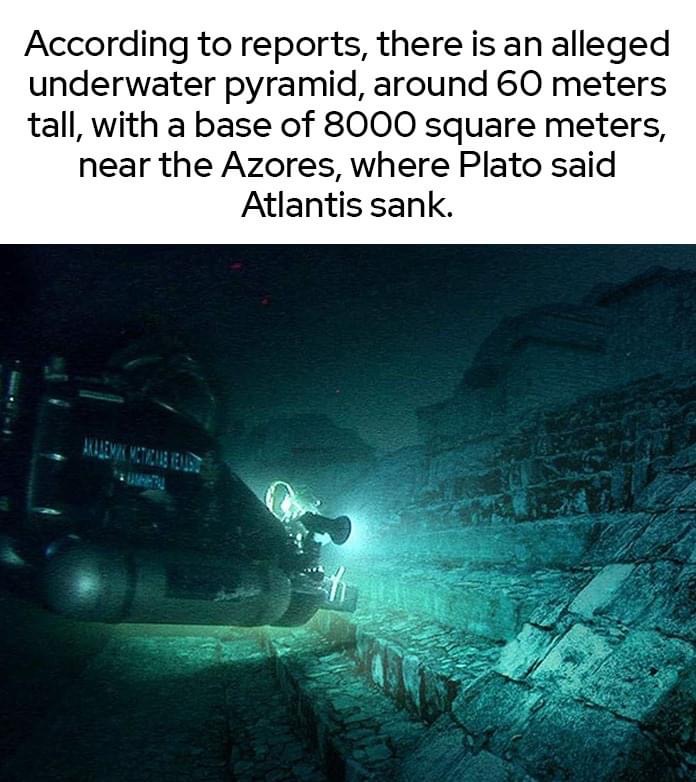
The discovery of the alleged pyramid has sparked debate among archaeologists and researchers. While some experts believe that it could be a man-made structure, others are skeptical and consider it to be a natural formation. The main argument against the idea of an underwater pyramid is that it would be impossible for ancient civilizations to build such a structure, given the technology available at the time.
However, there are also many arguments in favor of the idea of an underwater pyramid. For example, the discovery of the Yonaguni Monument off the coast of Japan in the 1980s provided evidence that ancient civilizations were capable of building large, underwater structures. The monument is believed to be around 10,000 years old and has a similar design to the alleged pyramid near the Azores.
Another argument in favor of the idea of an underwater pyramid is the fact that there are many ancient myths and legends that speak of a great civilization that sank beneath the waves. Plato’s story of Atlantis is perhaps the most famous of these, and many people believe that the discovery of the alleged pyramid near the Azores provides evidence of the existence of this lost civilization.
Despite the skepticism surrounding the idea of an underwater pyramid near the Azores, many researchers and explorers continue to search for evidence of its existence. In recent years, there have been several expeditions to the area to try and locate the structure and gather more information about it. Some of these expeditions have even used advanced technology such as submersible drones to explore the area.
In conclusion, the alleged discovery of an underwater pyramid near the Azores has sparked debate and controversy among archaeologists and researchers. While some experts believe that it could be a man-made structure, others are skeptical and consider it to be a natural formation. Regardless of whether or not the pyramid is real, the discovery has reignited interest in the story of Atlantis and the possibility that ancient civilizations were capable of building large, underwater structures. As technology continues to improve, it is likely that we will learn more about this mysterious structure and the secrets that it may hold.
If you enjoyed reading this blog post and found it informative, we kindly ask that you consider leaving us a comment below and liking and sharing it with your friends and family. By doing so, you’ll be helping us reach a wider audience and spreading valuable information to those who may find it helpful. Additionally, your support means a lot to us, and it motivates us to continue creating high-quality content that you’ll enjoy. So, thank you for taking the time to read our blog, and we hope to see you again soon!
Readers: Note that the email address and logging in prompts do appear for comments on this blog, but providing an email address and logging in are not required.
 The Inquisitive Journal