In today’s world, conformity is often seen as a necessary part of fitting in and being accepted. We are constantly bombarded with messages from society, telling us what to wear, how to act, and what to believe. It’s no wonder that many people find themselves conforming to these norms, even if they don’t fully agree with them.
But is conformity always the right choice? Is it always the moral choice? The answer, of course, is no. Conformity can lead to a dangerous kind of groupthink, where people stop thinking for themselves and just go along with what everyone else is doing. In these situations, it’s easy for immoral or unethical actions to be rationalized as “just following orders” or “going with the flow.”
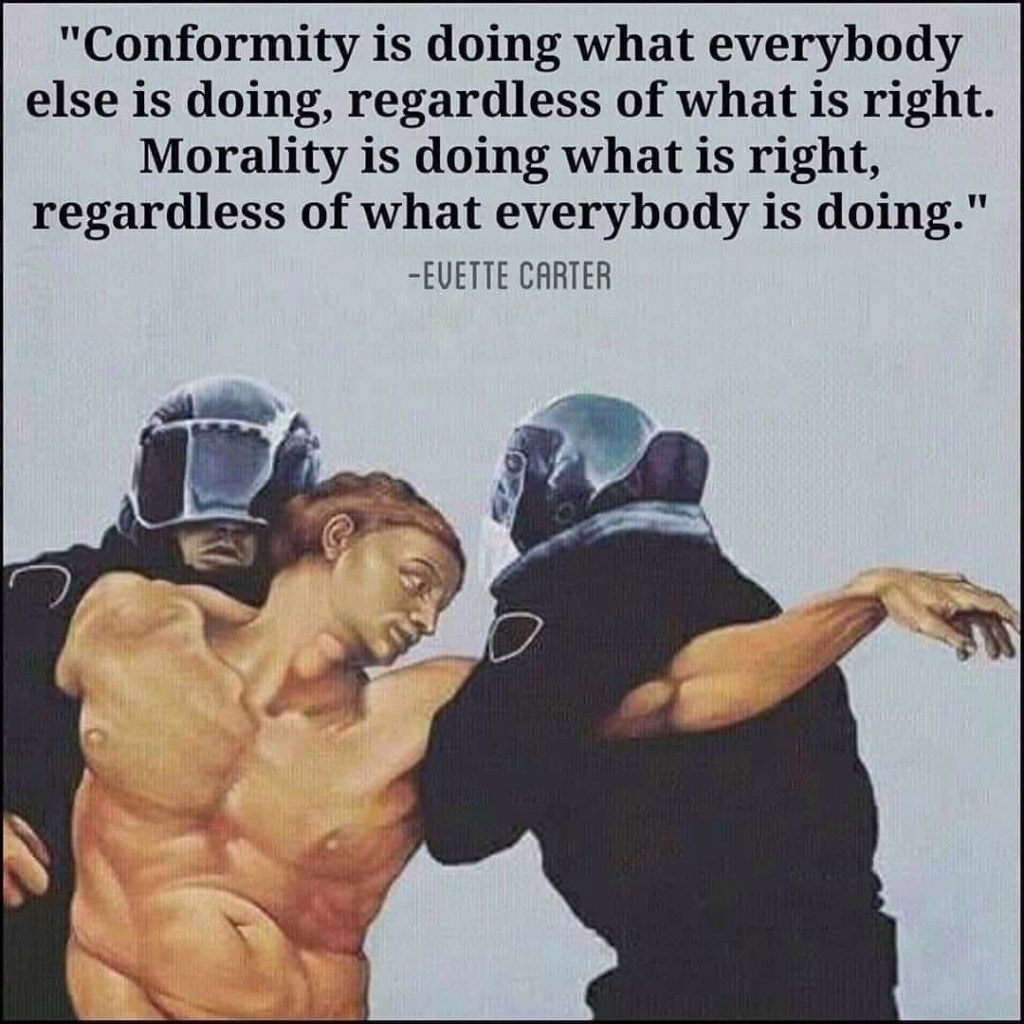
Morality, on the other hand, is about doing what is right, regardless of what everyone else is doing. It requires us to think critically and independently, to question the status quo and make decisions based on our own values and beliefs. It can be difficult to stand up for what is right when everyone else is doing the opposite, but it is often the only way to make real change in the world.
One of the most famous examples of someone who stood up for their own morality, even when it was unpopular, is Rosa Parks. In 1955, Parks refused to give up her seat on a bus to a white passenger, as was required by law at the time. This simple act of defiance sparked the Montgomery Bus Boycott, a year-long protest that eventually led to the desegregation of public transportation in Montgomery, Alabama. Parks’ refusal to conform to unjust laws was a powerful example of the importance of standing up for one’s own morality.
Of course, not all acts of morality are as dramatic as Parks’ refusal to give up her seat. Sometimes, it can be as simple as speaking up when someone makes a racist or sexist joke, or refusing to participate in gossip or other harmful behavior. These small acts of defiance can have a big impact, not just on the people around us, but on the world as a whole.
Conversely, conformity can lead to a dangerous lack of accountability. When everyone is doing the same thing, it can be easy to pass the buck and say “I was just following orders.” This mentality has been used to justify some of the worst atrocities in history, from the Holocaust to the My Lai massacre in Vietnam. It’s important to remember that just because everyone else is doing something, that doesn’t make it right.
Of course, there are times when conformity can be a good thing. For example, when it comes to obeying the law or following safety regulations, conformity is often necessary for the greater good. However, even in these situations, it’s important to remember that blind conformity can be dangerous. We should always strive to understand why a particular law or regulation exists, and to speak out when we believe it is unjust or unethical.
In conclusion, conformity and morality are often in conflict with one another. While conformity can be a useful tool for fitting in and following rules, it can also lead to a dangerous kind of groupthink that can rationalize immoral or unethical behavior. On the other hand, morality requires us to think critically and independently, to stand up for what is right even when it is unpopular or difficult. Ultimately, it is up to each of us to decide when to conform and when to stand up for our own morality, and to remember that doing what is right is often the only way to make real change in the world.
If you enjoyed reading this blog post and found it informative, we kindly ask that you consider liking and sharing it with your friends and family. By doing so, you’ll be helping us reach a wider audience and spreading valuable information to those who may find it helpful. Additionally, your support means a lot to us, and it motivates us to continue creating high-quality content that you’ll enjoy. So, thank you for taking the time to read our blog, and we hope to see you again soon!
 The Inquisitive Journal