Astronomers recently announced a remarkable discovery: the closest pair of supermassive black holes ever recorded. The gap between these two black holes is “fairly close to the limit of what we can detect, which is why this is so exciting,” according to Chiara Mingarelli, one of the study authors and an associate research scientist at the Flatiron Institute’s Center for Computational Astrophysics in New York City.
Supermassive black holes are truly massive, with the two black holes in question each being approximately 200 million and 125 million times the mass of our sun. They are also incredibly difficult to find, as black holes don’t emit light and must be located using indirect clues such as their effect on spacetime, the behavior of nearby stars, and gravitational waves produced when black holes collide.
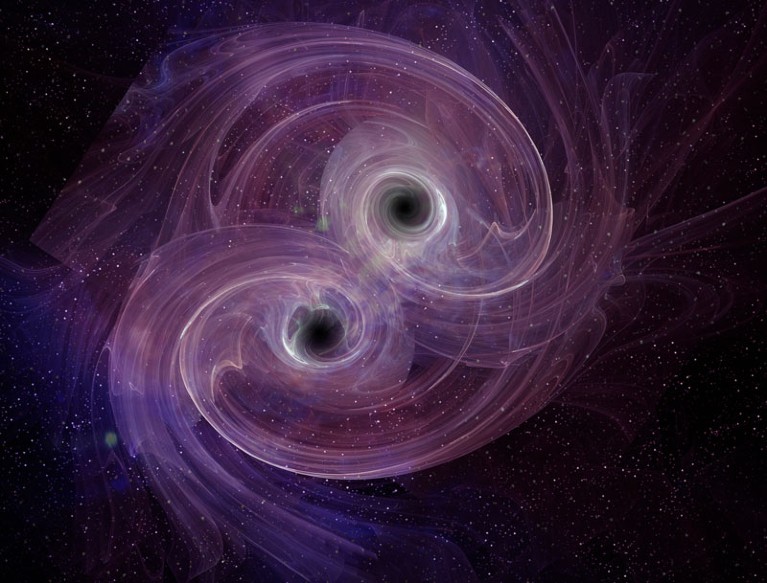
In order to locate these supermassive black holes, a team of 29 scientists analyzed data from a dozen instruments across seven telescopes, including the Hubble Space Telescope and the Keck Observatory in Hawaii. They were studying UGC 4211, a galaxy located in the constellation of Cancer, and discovered two black holes at its center. The discovery was published in the Astrophysical Journal Letters.
These two supermassive black holes appear to be the same size and are positioned incredibly close together, making this the closest pair ever recorded. Despite this, they are still positioned a safe 480 million light-years away from our Milky Way.
Eventually, the two black holes will collide and produce one of the largest explosions in the universe, sending out gravitational waves that will ripple throughout the entire universe. Although this won’t happen any time soon, the discovery of this pair of supermassive black holes is still incredibly exciting and provides new insights into the universe and its many mysteries.
The consequences of this collision will be immense. The explosion that will be produced by the collision will be incalculable, sending out ripples of gravitational waves throughout the entire universe. The merging of these black holes may also be more common than previously believed, and the discovery of this close pair provides more evidence for that theory.
 The Inquisitive Journal