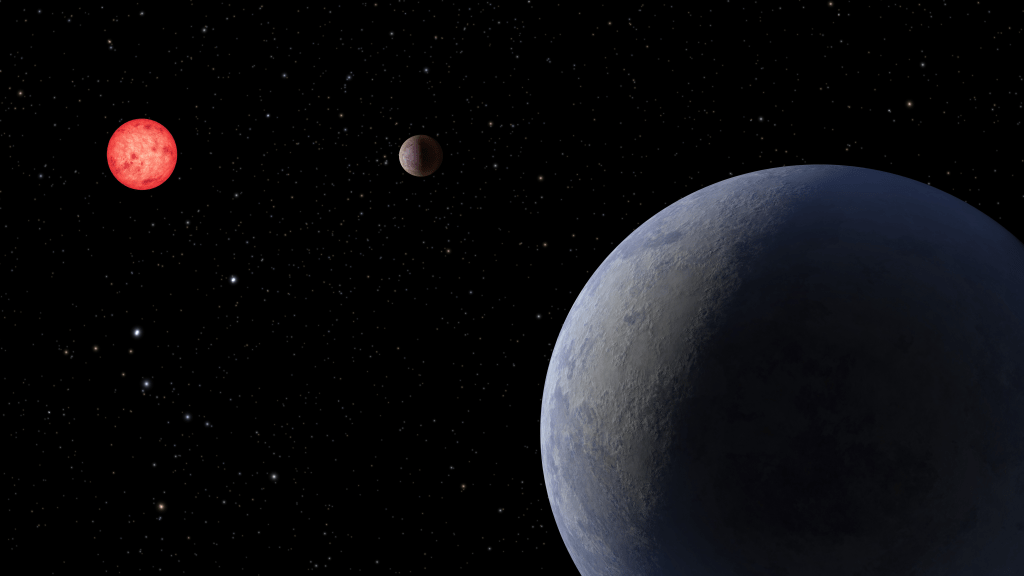
In a major breakthrough for exoplanetology and astronomy, two Earth-like planets have been discovered in outer space. Named LP 890-9b and LP 890-9c, these planets exhibit all the key characteristics that astronomers look for when searching for life in the universe.
Both LP 890-9b and LP 890-9c are stony, terrestrial planets with a solid surface and lack gases, which makes them ideal candidates for the existence of life. Their host system, which is the second coldest star with planets in orbit, has been referred to by NASA as a “Goldilocks star”. This is because its constant, relatively temperate emissions are ideal for the existence of life.
One of the planets, LP 890-9c, has even more exact specifications for producing and sustaining life than the other. This planet is located in its host star’s habitable zone, which is an area where the surface temperature would allow water to remain liquid for billions of years.
Amaury Triaud, professor of Exoplanetology at University Birmingham and leader of the research, explains that this discovery gives us a license to observe more and find out whether the planet has an atmosphere. If so, it would allow us to study its content and assess its habitability.
LP 890-9c is 40% larger than Earth and completes an orbit around its host star in just eight and a half days. According to a press release from the University of Birmingham, the James Webb Space Telescope could be instrumental in observing the atmosphere of LP 890-9c.
The importance of detecting as many temperate terrestrial worlds as possible cannot be overstated, according to Professor Triaud. Studying the diversity of exoplanet climates will help us understand how frequently biology has emerged in the cosmos, and how life may have evolved elsewhere in the universe.
However, observing these distant planets is a challenge due to the great distance between the LP 890-9 system and Earth’s telescopes. Our observations took place 100 million years ago, meaning that the light from the star may have travelled millions of kilometres to reach our space observatories.
The discovery of these two Earth-like planets is an exciting development in the field of astronomy and exoplanetology. It opens up new avenues for exploration and research, and provides us with valuable insights into the potential for life in the universe.
The search for life in the universe has been a long-standing quest for scientists and astronomers, and this discovery takes us one step closer to answering some of the most fundamental questions about our place in the cosmos.
In conclusion, the discovery of LP 890-9b and LP 890-9c is a major milestone in our search for life in the universe, and provides us with a glimpse of what may be possible in the years to come. With the continued advancements in technology, we can expect to see many more exciting discoveries in the near future, and this is just the beginning of our journey to explore the vastness of the cosmos.
 The Inquisitive Journal