The edge of the solar system is a mysterious place, where the heliosphere (the bubble of solar wind encompassing the solar system) meets the interstellar medium (the material between the stars). This boundary, called the heliopause, has been found to be more dynamic than previously thought. Scientists have used data from the Voyager 1 and Voyager 2 spacecraft, as well as NASA’s Interstellar Boundary Explorer (IBEX) satellite, to study the heliopause and create models that predict its changes.
However, recent findings have challenged previous understanding of the heliopause. Over a period of several months in 2014, IBEX detected brightening of energetic neutral atoms (ENAs) that indicated asymmetries in the heliopause, which were incongruous with the models. In reviewing data from Voyager 1 and Voyager 2, scientists also discovered that the heliopause changed dramatically in a short period of time, which contradicts the models.
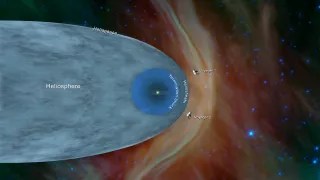
In a paper published in the journal Nature Astronomy, the researchers called these discrepancies “intriguing and potentially controversial.” They plan to continue their studies, hoping to gain more insight from NASA’s upcoming Interstellar Mapping and Acceleration Probe.
Until then, the mysterious rippling of the heliopause at the edge of the solar system remains a haunting and eerie phenomenon.
 The Inquisitive Journal