Recently, a new study has been published in the journal Astrobiology suggesting the possibility of an ocean on the nearby exoplanet, Proxima b. This newfound discovery raises the question of whether or not the planet could support life.
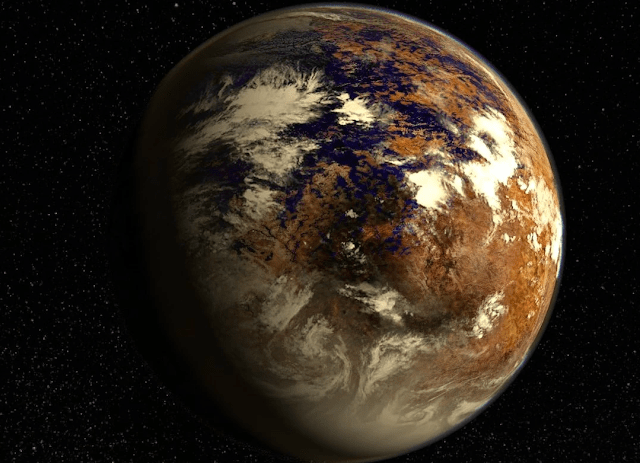
Proxima b is located just 4.2 light-years from Earth, orbiting within the habitable zone of a red dwarf star that is similar in age to our sun. The planet’s mass is roughly 1.3 times that of Earth’s, leading scientists to wonder about the conditions on its surface. Studies in the past have both strengthened and dismissed the possibility of Proxima b’s habitability, but the latest research once again raises the possibility of the exoplanet sustaining liquid water.
The study in question ran the first climate simulations of Proxima b with a dynamic ocean, and found that under the right conditions, the planet could potentially support liquid water. The planet is believed to be tidally locked to its star, meaning it would have a permanent “dayside” and “nightside”. While any water on the side facing away from the star would be frozen, the side facing the star could potentially have liquid water. The simulations showed that “with a dynamic ocean, a hypothetical ocean-covered Proxima Centauri b with an atmosphere similar to modern Earth’s can have a habitable climate with a broad region of open ocean, extending to the nightside at low latitudes.”
It’s important to keep in mind, however, that this study is just one possible scenario of many, and the probability of the conditions being exactly as described is still uncertain. Additionally, the planet’s proximity to a red dwarf star raises concerns about intense radiation and flares which could make the environment uninhabitable. Also, the fact that Proxima b is so far away, means that it will be very difficult to study in detail, which will make any confirmations about habitability or biosignatures very hard to obtain.
While the study’s results are exciting, much more research and observation is needed to confirm these findings and to understand the planet’s environment and conditions. The discovery of Proxima b and the possibility of an ocean on the planet have reignited interest in the search for habitable exoplanets and the search for life beyond our solar system. It’s a reminder that the search for life on other worlds is a vast and complex endeavor, but it is a worthy one as it helps us understand not only about other possible places for life, but also about our own place in the universe.
 The Inquisitive Journal